Rise in Sea Level
The above image is retrieved from:
US Global Change Research Program. (n.d.). Sea Level Rise. Retrieved November 20, 2019, from https://www.globalchange.gov/browse/indicators/global-sea-level-rise.
Canada “comes out very well”
— Benjamin Strauss .
Sea Level will Continue to Rise by Kevin
What people originally know, that an increasing steady rise in global sea level has occurred and continue to occur, has changed. Global sea level rise is accelerating, particularly in the last decades. It is expected the sea level will rise about an extra 2 feet (26 inches or 65 centimeters) by the year 2100 (Weeman, 2018). Take a look at the satellite sea level observations image below.
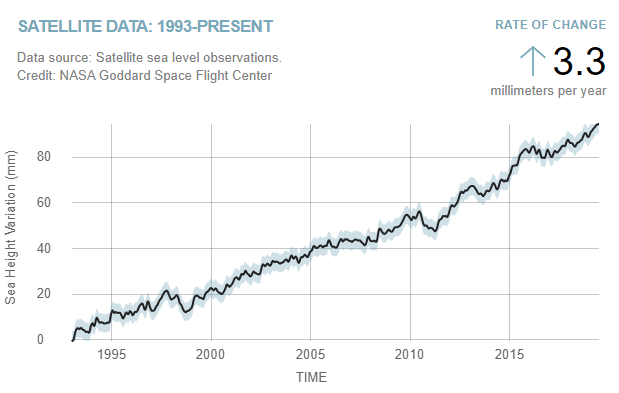
There are two main factors attributing to the rise in global see levels, increasing temperature of water and increase in land ice melting. As the Earth continues to increase in temperature, the temperature of the air and water also increases. This causes the water to be warmer. Warm water will expand, sea level rises. With the increase in Earth’s temperature, land ice is melting and flow into the ocean. Two places in particular are the land ice in Greenland and Antarctica (Weeman, 2018).
Such a rise in global sea level is very worrying as it can cause significant issues for coastal cities (Weeman, 2018). It is not just coastal cities that are negatively affected. Rising sea levels can also contaminate our freshwater sources, underground or on the surface, with sea water, cause erosion of soil, and affect all the infrastructure such as roads, water treatment, and transit systems. The side effects could lead to massive negative social and economic impact. By 2050, a minimum of 570 cities and a potential 800 million of its people could be exposed to rising sea level, storm surges, and floods. We are already seeing the effects of chronic flooding today. Venice was recently in the news for their floods. More than 90 US cities see chronic flooding and is expected to double by 2030 (Muggah, 2019). Some may think that is just 90 cities, but one needs to keep in mind that 40% of US citizens lives on the coast. That is about 130 million people that could be affected by rising sea levels (US Department of Commerce, 2008). Take a look at the Youtube video to learn more about sea level rise in other cities (Verge Science, 2019).
Canadian Connection
Canada is bordered by the Pacific Ocean in the West and the Atlantic Ocean in the East. So, what does a rise in sea level means for Canada. A report commissioned by the Environment and Climate Change Department shows that sea level could rising between one millimetre and 4.5 millimetre. See the image below for a look at how much sea level rise could Canada’s coast get by the end of the century (Hennig, 2019).

Overall, Canada “comes out very well” as it is still dealing with the effects of the last Ice Age. Many of the land is actually rising, keeping pace with rising sea level. Of course, there are areas in Canada that will see the effects of the rise in sea level, but it is mainly the coastal cities. Even places like Attawapiskat, that borders the Hudson Bay, is affected. There is currently 840,000 Canadians who live on land that can see annual flooding. Despite the good news for most of Canada, the benefit of reducing the country’s emission is much better than to not do anything (Shah, 2019).
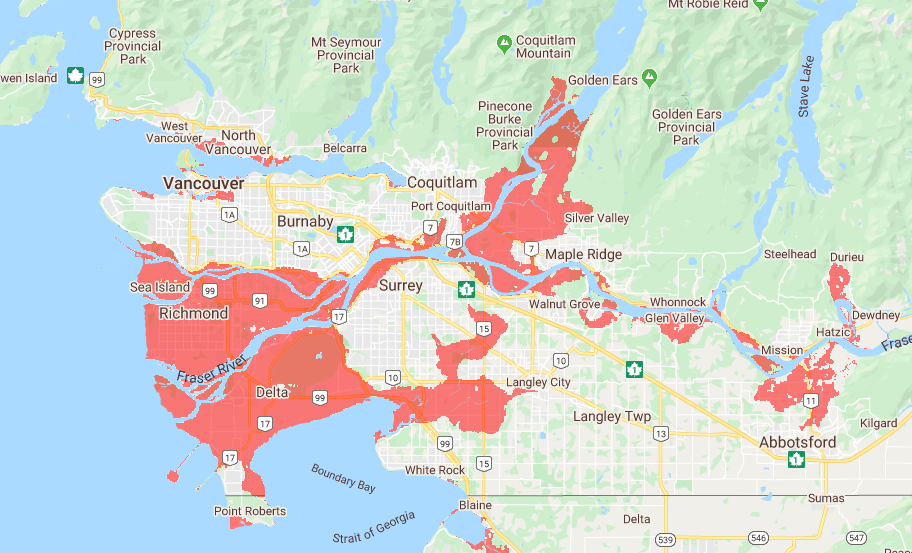
Take a look at this map to see areas that could be affected by the rise in sea level. Below is an image of Vancouver and the red highlights areas that may be affect by rise in sea level (Climate Central, n.d.).
References
Climate Central. (n.d.). A Global Screening Tool by Climate Central. Retrieved November 16, 2019, from https://coastal.climatecentral.org/map/10/-122.6231/49.2398/?theme=sea_level_rise&map_type=coastal_dem_comparison&elevation_model=coastal_dem&forecast_year=2050&pathway=rcp45&percentile=p50&return_level=return_level_1&slr_model=kopp_2014.
Hennig, C. (2019, April 3). Canada’s sea levels are rising – and that’s got British Columbians in coastal cities concerned | CBC News. Retrieved November 16, 2019, from https://www.cbc.ca/news/canada/british-columbia/climate-change-report-bc-coastal-cities-1.5083449.
Muggah, R., & SecDev Group. (2019, January 16). The world’s coastal cities are going under. Here’s how some are fighting back. Retrieved November 16, 2019, from https://www.weforum.org/agenda/2019/01/the-world-s-coastal-cities-are-going-under-here-is-how-some-are-fighting-back/.
NASA. (2019, June 28). Sea Level. Retrieved November 16, 2019, from https://climate.nasa.gov/vital-signs/sea-level/.
Shah, M. (2019, October 30). 300 million people currently live in areas threatened by rising sea levels, study finds. Retrieved November 16, 2019, from https://globalnews.ca/news/6099866/rising-sea-levels-300-million-people/.
US Department of Commerce, & National Oceanic and Atmospheric Administration. (2008, October 27). Is sea level rising? Retrieved November 16, 2019, from https://oceanservice.noaa.gov/facts/sealevel.html.
Verge Science. (2019, April 23). This is what sea level rise will do to coastal cities. Retrieved November 16, 2019, from https://www.youtube.com/watch?v=6tesHVSZJOg.
Weeman, K. (2018, June 13). New study finds sea level rise accelerating – Climate Change: Vital Signs of the Planet. Retrieved November 16, 2019, from https://climate.nasa.gov/news/2680/new-study-finds-sea-level-rise-accelerating/.
 Climate Change